
Destiny 2's Loose SBMM Exploit and the Never-Ending Matchmaking Dilemma
Destiny 2 Crucible exploit: Season of Plunder Loose SBMM loophole let low-K/D leaders farm easy wins. A cautionary matchmaking tale.
In the world of Destiny 2, few topics spark as much debate as the Crucible. Back in Season of Plunder, players found an easy PvP exploit less than a week into the new season. It allowed them to match against easier opponents and essentially guarantee a win almost every time. The trick was not a cheat, not a network manipulation tool, and not a hidden glitch in the game code. It was a matchmaking loophole tied to Bungie's new 'Loose SBMM' experiment. Even in 2026, the story remains a useful case study for how fragile competitive integrity can be.
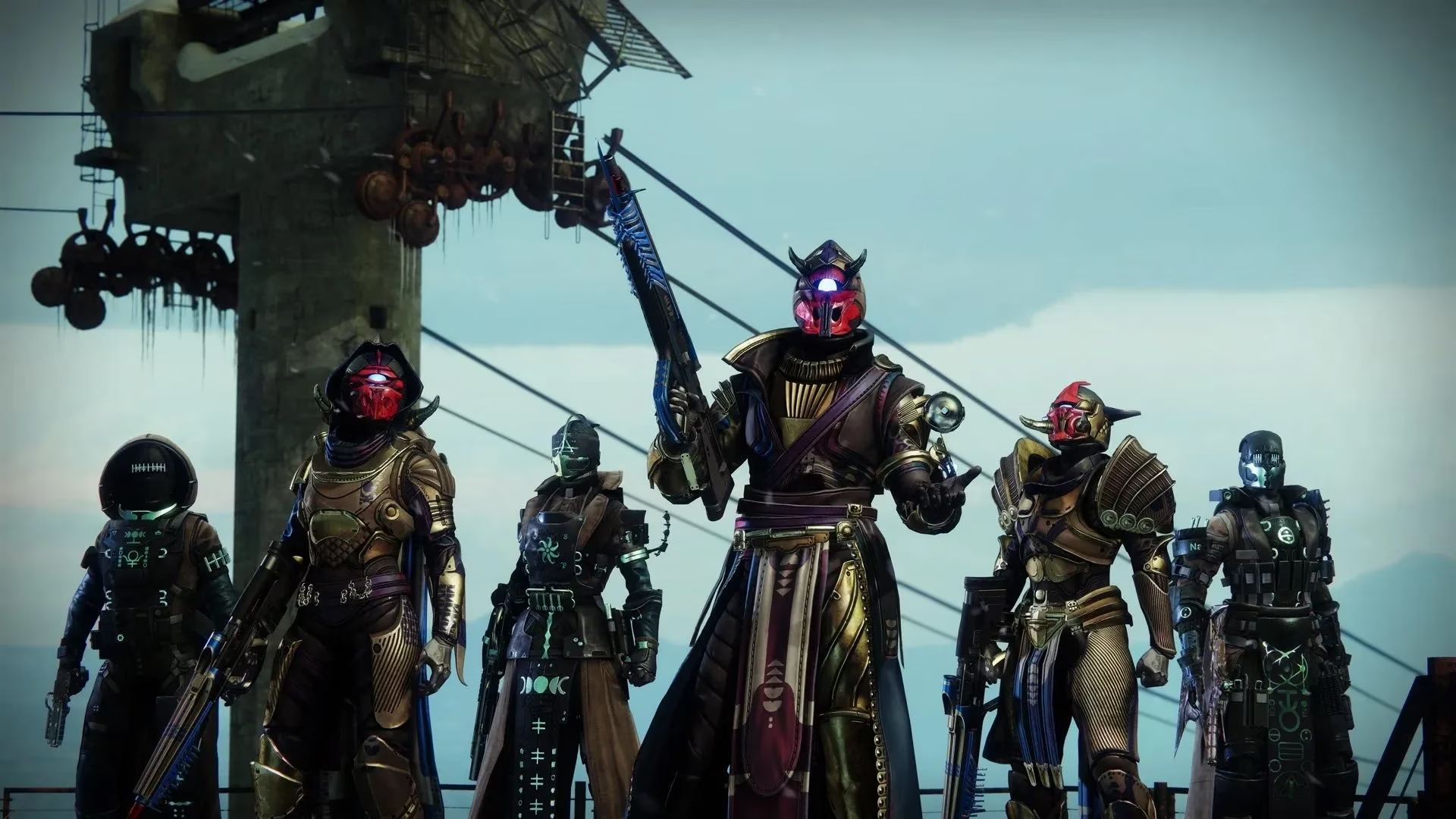
What was Bungie trying to do? The studio announced that Season of Plunder would introduce a 'Loose SBMM' system for the Control game mode in PvP. It was a test. Control had previously used 'Connection-Based Matchmaking', or CBMM. CBMM matched teams with players whose connection strengths were similar to their own. That approach prioritized stable lobbies over perfectly balanced competition. Loose SBMM did not completely remove CBMM's foundation, but it made skill the primary criterion for matchmaking. Bungie even detailed how it defined skill in Destiny 2. The intent was understandable: give players fairer matches. The execution, however, quickly ran into trouble.
The community called it out. Many argued that loose SBMM could ruin the overall PvP experience for new players. After all, if matchmaking becomes too strict, casual players can feel punished for improving. If it becomes too loose, skilled players can stomp weaker lobbies. Is there any perfect middle ground? That question has haunted online shooters for years, and Destiny 2 was no exception.
Then came the exploit. It was simple, almost embarrassingly so. All a player had to do was join the fireteam of someone with a seasonal K/D of one or less. Once in the same party, that low-K/D player had to be the fireteam leader and start matchmaking. Because the system used the leader's skill as a key reference point, the group would almost always match against opponents with a skill level similar to the leader. In other words, a squad of strong players could hide behind one weaker account and farm easier lobbies. Bungie had mentioned earlier that it wanted to prioritize matching full teams against full teams instead of placing solo players into team-heavy matches. That goal made sense on paper. In practice, it gave coordinated groups a workaround: make the lowest-skilled player the leader, and wins become nearly guaranteed.
Why did this happen? Matchmaking systems are built on assumptions. One assumption is that the party leader represents the group's skill. Another is that fireteams are relatively balanced internally. Both assumptions fail when players deliberately manipulate the system. The exploit did not require cheating software. It required only social coordination and a basic understanding of how loose SBMM evaluated lobbies. That is what made it so frustrating for the wider community.
It is important to note that no game has ever had a perfect SBMM system. Matchmaking is different for every game, every mode, and every regional population. What works for a battle royale may fail in a 6v6 objective mode. What works in a high-population region may collapse in a low-population one. Consequently, it was too early to call Bungie's implementation a total failure. Other than this one exploit, there was a lot more to the system than met the eye. The problem was not that SBMM existed. The problem was that its rules could be gamed.
This season had already seen its fair share of game-breaking exploits. Heavy grenade launchers caused chaos. A brand new exotic Auto Rifle added another layer of imbalance. Tough times, indeed. For a live-service game, that combination of technical exploits and matchmaking frustration can erode trust quickly. Players begin to ask: If the system can be tricked so easily, what is the point of playing fair? If every lobby is a coin flip or a setup, why care about improvement?
A simple comparison helps explain the tension.
| Matchmaking type | Primary factor | Strength | Weakness |
|---|---|---|---|
| CBMM | Connection quality | Stable lobbies, fast matches | Skill gaps can be huge |
| Loose SBMM | Skill, with connection still considered | Fairer matches on paper | Can be exploited by fireteam leaders |
| Strict SBMM | Skill above all | Competitive balance | Longer queues, sweatier lobbies, regional issues |
The table shows why developers rarely get an easy answer. Every system trades one problem for another. The Destiny 2 exploit was not proof that skill-based matchmaking is impossible. It was proof that matchmaking needs safeguards against player behavior, not just good intentions.
In 2026, the debate has not disappeared. Live-service shooters continue to experiment with hybrid systems, dynamic tuning, and separate playlists for competitive and casual audiences. Some games use average fireteam skill instead of leader skill. Others weight the highest-skilled player more heavily. Some add transparency dashboards so players can see how lobbies are formed. None of these solutions is flawless, but they show that the industry learned something from incidents like the Season of Plunder exploit. The key is to assume that some players will always look for the shortest path to an easy win.
So what should developers take from this? First, never let a single account's stat define an entire fireteam's matchmaking bracket without additional checks. Second, monitor for suspicious party compositions and sudden win-rate spikes. Third, communicate changes clearly, because trust in matchmaking is as important as the algorithm itself. Finally, accept that competitive integrity is an ongoing process, not a one-time patch.
Destiny 2's loose SBMM exploit was a small loophole with a large lesson. It showed how quickly a well-meaning system can be turned against itself. It also reminded players that the Crucible is not just a test of aim and movement. It is a test of design. Will future matchmaking systems learn from this? They must, because the alternative is a playlist where the only guaranteed winner is the exploit itself.